
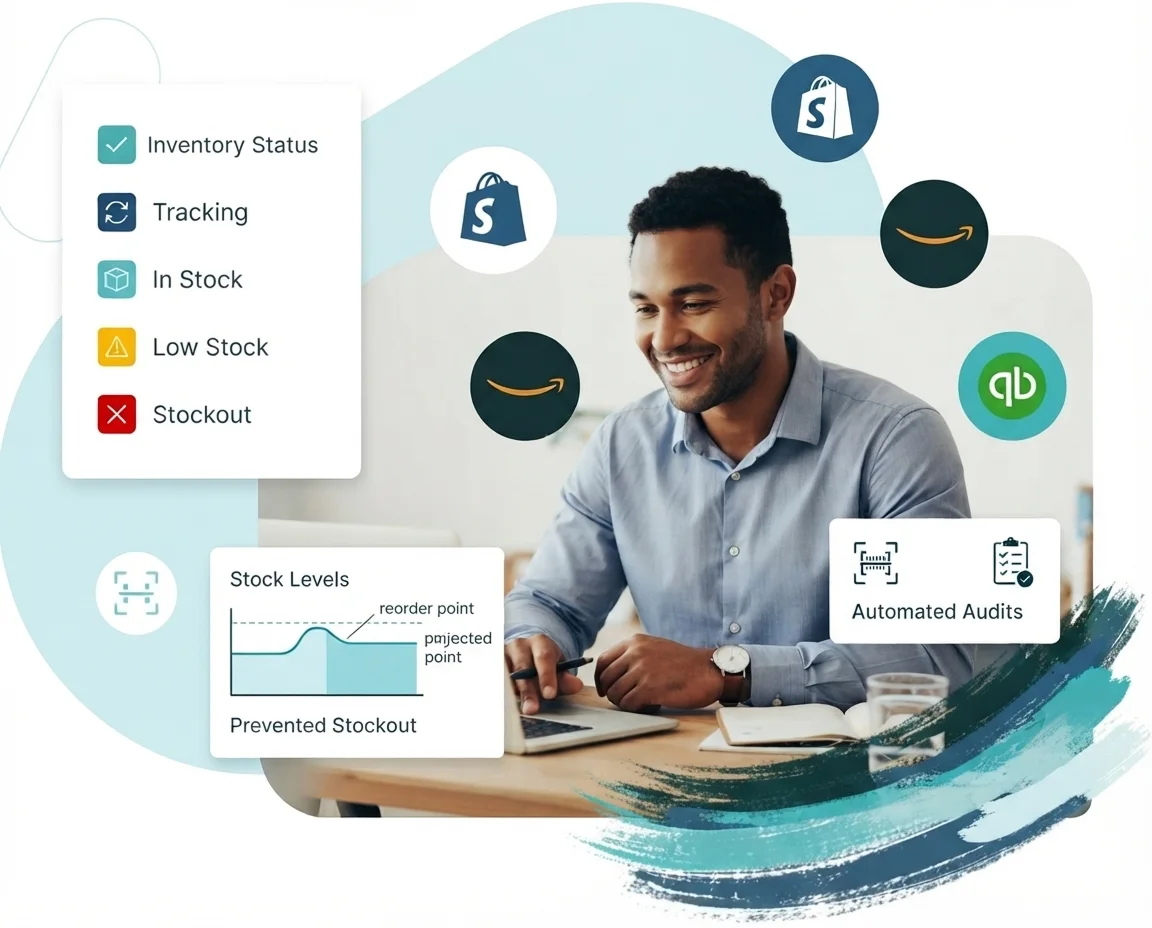
For e-commerce and retail businesses, few things are as damaging to a brand’s reputation and bottom line as a stockout. A customer lands on your site, ready to buy, only to find their desired item is unavailable. In many cases, they don’t wait; they simply click over to a competitor. On the flip side, carrying too much inventory ties up valuable capital and increases storage costs.
Managing this delicate balance is one of the most persistent challenges in modern commerce. The solution lies in moving away from outdated, manual processes and embracing modern technology that offers clarity and control. This is where Automated Inventory Audits become essential.
This blog post explores how implementing Automated Inventory Audits and real-time inventory tracking can transform your operations and effectively prevent stockouts, ensuring you always have the right product, at the right time, in the right place.
The High Cost of Relying on Manual Inventory Checks
For many businesses, inventory management is an afterthought until something goes wrong. The traditional approach often involves periodic physical counts or relying on static spreadsheets that quickly become outdated. This method is fraught with problems that affect every aspect of the business.
The Myth of “Good Enough” Data
When inventory counts are inaccurate, every business decision built on that data becomes questionable. A product might appear to be in stock when it’s actually sold out, leading to overselling and customer disappointment. Conversely, a slow-moving item might show low stock levels, triggering an unnecessary rush order that adds to already bloated inventory.
These errors are not just inconvenient; they are financially damaging. Research indicates that as much as $400 billion in retail revenue is lost due to incorrect store stock levels. These losses are often caused by “phantom inventory,” where the system says you have stock, but it’s not available for sale due to loss, damage, or misplacement.
Labor-Intensive and Disruptive Processes
Traditional physical inventory audits are a nightmare for warehouse teams. They require halting operations, dedicating staff to count every item, and hoping the data is entered correctly. This process is not only slow but is also a major source of human error.
One e-commerce accelerator, for example, found its manual aisle verification process was consuming a staggering 3,400 labor hours monthly. This is time and money that could be better spent on growth initiatives. Furthermore, when manual counts are performed infrequently—say, annually or quarterly—problems can fester for months before being discovered, multiplying the negative impact on sales and customer satisfaction.
The Hidden Costs of Inaccurate Inventory
Beyond the obvious lost sales, inaccurate inventory creates a cascade of hidden costs:
- Expedited shipping fees: When stockouts occur, rush orders from suppliers become necessary, often at premium rates.
- Storage waste: Overstocked items consume valuable warehouse space that could be used for faster-moving products.
- Labor inefficiency: Employees waste time searching for misplaced items or correcting inventory errors.
- Customer acquisition costs: Acquiring a new customer costs significantly more than retaining an existing one. Stockouts drive customers to competitors, wasting your marketing spend.
These costs compound over time, making manual inventory management an increasingly expensive proposition.
Automated Inventory Audits: A 21st-Century Solution
The answer to these challenges is to automate. Automated Inventory Audits use technology like barcode scanners, RFID tags, and intelligent software to continuously verify stock levels without the need for manual intervention or disruptive operational halts .
This shift from periodic to continuous verification is a core component of modern inventory management. Rather than being a once-a-year event, an audit becomes a constant, automated process that ensures data accuracy.
How It Works: Real-Time Tracking and Verification
Modern inventory systems can perform Automated Inventory Audits that are woven into the fabric of daily operations . For instance, cycle counting, a method of auditing a small subset of inventory on a rotating basis, can be automated. The system uses algorithms and anomaly detection to schedule counts for specific SKUs or locations, prioritizing high-value items or those with a history of discrepancies .
Advanced solutions take this even further. Robotics and data intelligence platforms can automate the entire physical counting process. For example, one logistics company integrated a robotics platform that improved pallet location accuracy by 14% and significantly sped up inventory counts, reducing labor hours and operational disruption . These automated processes can verify inventory in real-time, syncing data instantly with the warehouse and enterprise systems.
The Evolution from Manual to Automated Audits
The inventory audit has undergone a remarkable transformation. The traditional annual physical count, which required halting operations and dedicating entire teams to manual verification, is giving way to continuous, technology-driven processes. Automated Inventory Audits now enable businesses to verify stock levels daily or weekly, without disrupting core operations.
This shift represents more than just a technological upgrade; it fundamentally changes how businesses approach inventory accuracy. Rather than treating audits as an occasional compliance exercise, forward-thinking companies embed them into daily operations. By implementing real-time inventory tracking, businesses can catch and correct discrepancies before they escalate into business-disrupting events.
Consider the results achieved by DCL Logistics after implementing an advanced robotics and data intelligence platform. The company saw a 14% improvement in pallet location accuracy, a tenfold increase in inventory counting speed, and saved 16 hours of labor per day. These efficiencies freed the inventory team to focus on higher-value planning initiatives such as warehouse space optimization and customized customer projects.
Active vs. Passive Auditing: Two Approaches to Automation
The automation of inventory audits comes in two primary forms: active and passive.
Active Auditing: This involves dedicated scanning efforts—whether manual or automated—to verify stock levels. This might involve cycle counting routines triggered by algorithms that prioritize high-value or fast-moving items. Employees use handheld scanners or mobile devices to count specific items on a scheduled basis, guided by the system’s prioritization logic.
Passive Auditing: This represents a more innovative approach. It involves baking inventory verification into other activities that happen in the warehouse naturally. For example, forklift and order picker truck traffic can become opportunities for audit if the equipment is equipped with appropriate technology.
The Retina Robotics WAM device mounts to material handling equipment and uses on-board computer vision and AI to audit inventory placement without requiring manual scanning. These devices effectively give warehouse vehicles “eyes” that can instantly recognize and report when inventory isn’t where it should be.
This passive approach addresses one of the most persistent challenges in inventory management: accuracy during the “quiet hours” between receipts, picks, returns, transfers, and shelf movements. Annual stock counts might fix the numbers on paper, but they don’t fix the operational habits that cause errors. Automated Inventory Audits that run continuously in the background maintain accuracy between major counts.
The Power of Real-Time Inventory Tracking
At the heart of an effective automated system is real-time inventory tracking. This is the lifeblood of a modern operation, providing an up-to-the-second view of stock levels across all sales channels and warehouse locations .
Creating a Single Source of Truth
The goal of real-time inventory tracking is to eliminate data silos. When your e-commerce platform, physical stores, and 3PL partners all operate from the same, constantly updated pool of inventory data, you create a “single source of truth” . This synchronization ensures that as soon as a sale is made online or in-store, the inventory count is adjusted everywhere, instantly .
This visibility is key to making informed business decisions. With a centralized dashboard, you can:
- See what’s in stock, what’s on order, and what’s in transit.
- Identify best and worst-selling SKUs.
- Track performance across different channels and locations.
- Monitor supplier performance and lead times
- Generate accurate financial reports based on reliable inventory data
Reducing Errors with Technology
Real-time inventory tracking also reduces errors associated with manual data entry. Technologies like barcode scanning and RFID tagging automate the recording of stock movements, ensuring that data is captured accurately at the source . This level of precision is crucial for maintaining trust in your data and for meeting compliance obligations.
Reducing Errors with Technology
Real-time inventory tracking also reduces errors associated with manual data entry. Technologies like barcode scanning and RFID tagging automate the recording of stock movements, ensuring that data is captured accurately at the source. This level of precision is crucial for maintaining trust in your data and for meeting compliance obligations.
Shelf-Level Visibility and Store Intelligence
The quest for inventory accuracy has extended beyond the warehouse. Retailers now recognize that real-time inventory tracking must include shelf-level visibility within stores, especially as stores increasingly serve as fulfillment nodes for e-commerce orders.
Store inventory intelligence platforms now provide near-real-time updates on inventory counts and locations, refreshing data every few minutes. However, knowing how much inventory exists is no longer sufficient. Where it is located within the store matters enormously.
The cost of not knowing location adds up quickly in a ship-from-store environment. A few extra minutes spent searching for an item can erase any shipping savings and introduce labor inefficiencies. Modern solutions combine overhead RFID readers with execution platforms to identify on-shelf gaps and immediately direct store teams to execute corrective action.
This creates a closed-loop system where store activity feeds back into broader planning decisions. When inventory intelligence suggests putting something on the sales window, the same AI agent can determine the impact on the supply chain, adjusting replenishment, warehouse allocation, and transportation planning accordingly.
The Technologies Powering Inventory Automation
Several technologies enable real-time inventory tracking and Automated Inventory Audits:
RFID Technology: Radio frequency identification enables faster, more accurate scans. RFID capabilities embedded into audit flows allow for rapid verification of inventory without line-of-sight scanning. This is particularly valuable in complex environments like medical device management, where trays and kits must be validated against system expectations.
Computer Vision: Camera systems that detect damaged cartons, mismatched labels, or empty shelf space can remove significant manual verification work. Handheld AI tools and inventory counting solutions turn shelf checks into faster, more frequent inventory reads.
IoT Sensors: Smart shelves equipped with sensors can detect when items are removed or restocked, providing passive visibility without requiring human intervention. This creates a continuous audit trail of inventory movements.
Mobile Scanning: Barcode and RFID workflows let teams validate product, quantity, lot data, and location in a single motion, reducing rekeying and shortening dock time.
Drones and Autonomous Vehicles: Some warehouses are deploying drones equipped with RFID readers or cameras to perform automated inventory counts in hard-to-reach areas, further reducing labor requirements.
How Automated Audits Prevent Stockouts
For most businesses, the primary motivation for overhauling their inventory system is to prevent stockouts. A stockout isn’t just a lost sale; it’s a hit to your brand’s reliability and customer trust . Automated Inventory Audits and real-time inventory tracking provide the tools needed to keep products on shelves.
Proactive Replenishment
With real-time data, you can move from a reactive to a proactive replenishment strategy. Instead of waiting for inventory to run low, systems can use AI-powered forecasting and demand planning to predict future needs .
By analyzing historical sales data, current stock levels, seasonal trends, and supplier lead times, these systems can:
- Set dynamic reorder points that trigger purchase orders automatically when a specific threshold is reached.
- Calculate the optimal quantity to reorder based on forecasted demand and safety stock levels.
- Adjust replenishment schedules based on changing market conditions
- Account for promotional activities that may temporarily spike demand
Maintaining Safety Stock Intelligently
Real-time inventory tracking also helps you manage safety stock more effectively. This is the extra inventory kept on hand as a buffer against unexpected demand spikes or supplier delays. The goal is not to overstock, but to keep a calculated cushion for your most important items . Accurate, real-time data allows you to determine the right level of safety stock, preventing both stockouts and excessive carrying costs.
For example, a best-selling product with an unreliable supplier may require more safety stock than a slower-moving item with consistent lead times. The ability to differentiate safety stock levels based on real data rather than gut feeling is a significant advantage of automated systems.
Preventing Overselling
One of the most immediate benefits of real-time inventory tracking is its ability to prevent overselling. This common problem occurs when inventory is sold through one channel but not immediately reflected in another. When all channels are synced in real-time, the system will automatically prevent a customer from ordering a product that is no longer available.
This protection extends to:
- Buy online, pick up in-store (BOPIS) orders
- Ship-from-store fulfillment
- Marketplaces like Amazon and eBay
- Wholesale and direct-to-consumer channels
Demand Forecasting and Replenishment
While Automated Inventory Audits provide visibility into current stock levels, prevent stockouts also requires looking forward. AI-assisted forecasting enables businesses to adjust inventory plans weekly or even daily, making them less reactive and less likely to overbuy the wrong SKUs.
Good forecasting blends sales history, promotion calendars, lead-time shifts, and supplier risk into one reorder signal. It accounts for seasonality, demand spikes, and slow-moving items with erratic patterns. The goal is not perfect prediction but better planning based on available information.
For example, the 80/20 rule suggests that a minority of inputs often account for the majority of outcomes. Identifying these high-impact SKUs allows businesses to focus their inventory planning efforts where they matter most.
Dynamic Reorder Points and Safety Stock
A reorder point is the inventory level that triggers a new purchase order. Modern inventory systems can set these points dynamically based on sales velocity, supplier lead time, and safety stock requirements.
For example, if a product sells 5 units per day and the supplier takes 10 days to deliver, the business needs enough inventory to cover that 10-day window. If extra inventory is kept as a cushion, that amount should be included in the reorder point.
Safety stock represents extra inventory kept on hand to reduce the risk of running out. It provides a buffer when:
- Demand is higher than expected
- A supplier runs late
- Inventory counts are slightly off
- A promotion creates more orders than usual
The goal is not to overbuy every product. The goal is to keep backup inventory for products where a stockout would create bigger problems. A best seller may need more of a cushion than a slow-moving SKU, and a product with an unreliable supplier may need more backup than one that can be replenished quickly.
Conclusion: The Future of Inventory Management
The days of relying on gut feelings and outdated spreadsheets to manage inventory are over. In today’s fast-paced, omnichannel world, the businesses that thrive are those that embrace technology to gain a competitive edge.
Implementing Automated Inventory Audits and real-time inventory tracking is no longer a luxury; it’s a necessity. These technologies provide the clarity, accuracy, and control needed to prevent stockouts, reduce waste, and ensure customer satisfaction .
At [Your Company Name], we understand the complexities of modern inventory management. Our solutions are designed to help you automate your audits, track inventory in real-time, and prevent stockouts, so you can focus on what you do best: growing your business. Contact us today to learn more about how we can help you achieve inventory accuracy and operational efficiency.