
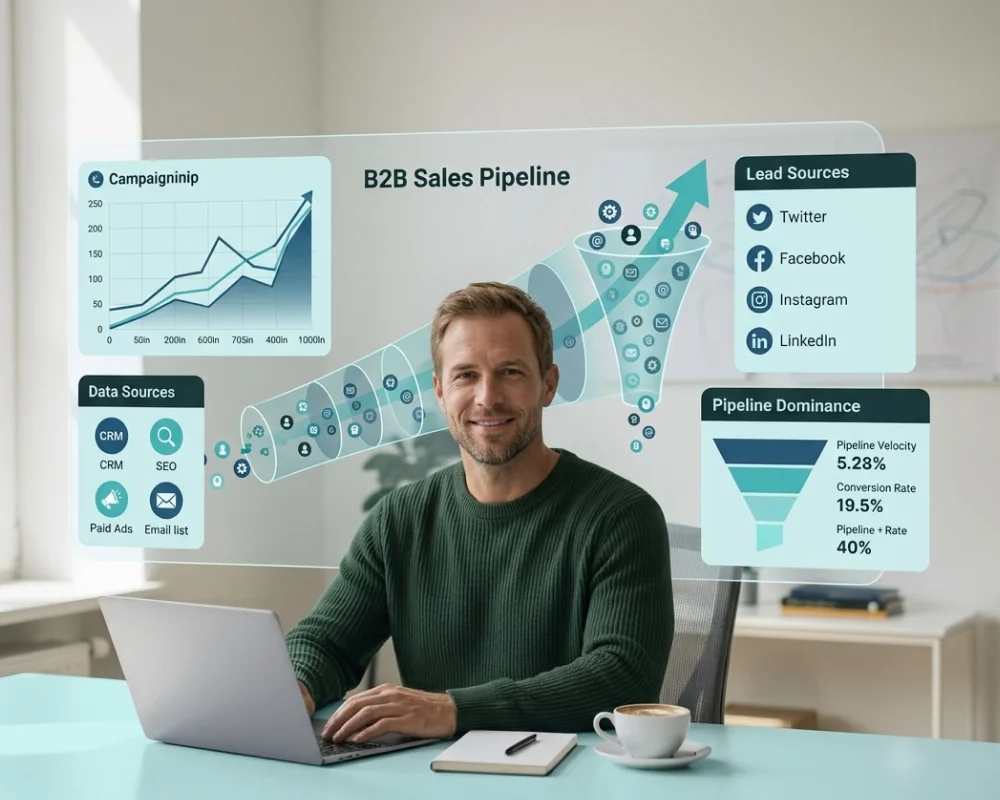
The landscape of B2B lead generation has fundamentally shifted. The days of spray-and-pray marketing, cold calling, and generic email blasts are fading into obsolescence. Today’s B2B buyers are digital-first, research-driven, and increasingly selective about who they engage with. They conduct the majority of their buying journey independently, involving multiple stakeholders before ever reaching out to sales.
For revenue teams, the challenge is clear: how do you build a predictable, scalable pipeline in an environment where buyers are harder to reach and more discerning than ever? The answer lies in data-driven digital marketing. This approach replaces guesswork with intelligence, turning your marketing efforts into a systematic engine for attracting, engaging, and converting high-value prospects. When executed properly, B2B lead generation becomes a repeatable process rather than a lucky break.
This blog post explores how to scale your B2B lead generation using data at every stage—from defining your ideal customer to leveraging AI and intent data to accelerate pipeline velocity.
The New B2B Reality: Why Data-Driven Marketing is Non-Negotiable
The landscape of B2B lead generation has fundamentally shifted. The reality is that the B2B buying process has evolved dramatically. What worked a decade ago is no longer effective for B2B lead generation, and clinging to conventional methods can mean losing market share to more agile competitors.
Here are three key trends reshaping B2B lead generation:
01.
The Self-Educating Buyer
Modern B2B buyers are doing their homework long before they speak to a sales representative. Research shows that buyers now complete around 83% of their buying journey digitally before contacting a vendor. They are educating themselves through blogs, webinars, whitepapers, and peer discussions in Slack communities or LinkedIn groups. This means by the time a prospect reaches out, they are often already 70-80% of the way through their decision-making process. Effective B2B lead generation must account for this self-directed research behavior.
02.
The Complex Buying Committee
B2B decisions are rarely made by a single individual. The average buying committee now consists of 6 to 13 decision-makers, each with their own priorities and perspectives. This complexity requires marketing to engage multiple stakeholders across the buying group, not just one champion. Successful B2B lead generation strategies address the needs of the entire buying unit.
03.
The “Dark Funnel”
Traditional tracking methods like form fills only capture a fraction of your total audience. Many prospects who are interested in your solution will not fill out a form. They may visit your pricing page multiple times, read case studies, and consume content without ever raising their hand. This “dark funnel” represents the vast majority of your potential pipeline—and it’s invisible to traditional analytics. Data-driven B2B lead generation solves this by revealing hidden buying signals.
To navigate this new reality, you need a strategy that is data-driven. You must use data to identify who’s in the market, what they’re interested in, and when they’re ready to buy—even if they never fill out a form.
Step 1: Build a Foundation with Your Ideal Customer Profile (ICP)
A scalable B2B lead generation strategy does not start with tactics like SEO or paid ads. It starts with a crystal-clear understanding of who you are trying to reach. Your Ideal Customer Profile (ICP) is a data-backed description of the companies that are most likely to become your best customers—those with the highest value, longest retention, and greatest potential for expansion.
How to Develop a Data-Driven ICP
A generic profile like “SMEs in Europe” is insufficient for effective B2B lead generation. You need a detailed, actionable profile built on data from your existing customer base.
01.
Analyze Your “Elephants”
As Red Panda Works founder Jordi Bron suggests, look at your “elephants”—the top 20% of your customers by lifetime value. Identify common characteristics: What industries do they operate in? What is their company size and revenue? What challenges do they face that your product solves? This analysis directly improves your B2B lead generation targeting.
02.
Define Firmographic and Technographic Data
Firmographics: Company size, industry vertical, geographic location, and growth stage.
Technographics: The technology stack they use. Do they run a competing solution? Are they using complementary tools that integrate with yours? This data is critical for understanding whether your solution is a technical fit .
03.
Understand the Decision-Making Unit (DMU)
Who makes the buying decision? Is it the CEO, the Head of Marketing, or a team of IT and Finance leaders? Knowing the roles and priorities of the DMU allows you to tailor your messaging to address their specific pain points. This is the cornerstone of effective B2B lead generation.
Making your ICP razor-sharp prevents you from wasting budget on irrelevant prospects and ensures you are focusing your marketing and sales efforts on the accounts that matter most. This is the first step towards efficient, data-driven B2B lead generation.
Step 2: Harness the Power of Buyer Intent Data
Once you know who your ICP is, you need to know when they are in the market to buy. This is where buyer intent data comes in. Traditional lead scoring based on firmographics alone is no longer sufficient for modern B2B lead generation. Intent data provides real-time insights into what potential customers are actually doing—which companies are actively researching solutions like yours.
Types of Intent Data
First-Party Intent Data: This is data you collect directly from your own digital properties. For example, a company that visits your pricing page multiple times, downloads a whitepaper, and attends a webinar is demonstrating high intent. Capturing this data supercharges your B2B lead generation efforts.
Third-Party Intent Data: This is data aggregated from across the open internet. It tracks B2B buyers’ research behavior on industry publications, review sites, and competitor pages. This allows you to identify companies in the earliest stages of research who may not have found you yet, expanding your B2B lead generation reach.
Putting Intent Data to Work
Intent data is the fuel for a data-driven lead generation engine. It allows you to:
Engage Accounts at the Right Time: You can tailor your outreach to match where a prospect is in their buying journey. A company researching solutions for the first time needs educational content, while a company comparing specific vendors needs case studies and ROI calculators.
Personalize Your Messaging: If you know a prospect is researching a specific pain point or competitor, you can craft messages that directly address that context.
Step 3: Build Your Data-Driven Channel Strategy
With a clear ICP and intent data capabilities, you can select the channels that will be most effective in reaching your target audience. The goal is not to be everywhere, but to be present on the channels where your ICP spends their time, with the right message at the right time.
01.
SEO and Content Marketing: The Foundation of Trust
While paid channels deliver speed, organic search and content are the engine of sustainable, long-term growth.
Why SEO? Most B2B buyers begin their research with a search engine. If you aren’t visible for the keywords your prospects are searching, you are invisible to a significant portion of your potential market . Search is where prospects are demonstrating intent. For example, a search for “visitor identification software” signals active interest.
What Kind of Content? Content marketing is not about product brochures; it’s about providing genuine value. High-performing B2B content is focused on building authority and trust. This includes:
What Kind of Content? Content marketing is not about product brochures; it’s about providing genuine value. High-performing B2B content is focused on building authority and trust. This includes:
- Original Research & Data: Reports and benchmarks that your audience can’t find anywhere else.
- In-Depth Guides and How-To Articles: Answering your prospects’ most pressing questions. For instance, a blog post on “How to convert website visitors into customers” draws in people with a clear problem .
- Customer Case Studies: Social proof is incredibly powerful. Let your customers tell the story of how you solved their problem.
Leading companies that publish 15 or more blog posts per month generate an average of 1,200 new leads per month, demonstrating the compounding power of a strong content engine.
02.
LinkedIn: The Undisputed King of B2B Social
LinkedIn generates 80% of all B2B social media leads and is 277% more effective for lead generation than Facebook and Twitter combined . Its targeting capabilities are unmatched for B2B, allowing you to reach decision-makers by job title, industry, company size, and more.
Organic Thought Leadership: Content shared from personal profiles often outperforms company page posts. Sharing practical insights and engaging in industry discussions builds a network that eventually delivers customers.
LinkedIn Ads: While more expensive than other platforms, the quality of leads is higher. LinkedIn Lead Gen Forms convert at an average of 13%, compared to just 2.35% for standard landing pages . Combining your first-party data (like website visitors) for retargeting on LinkedIn is a powerful way to stay top-of-mind with warm prospects.
03.
Paid Search (Google Ads): Capturing High-Intent Traffic
In digital marketing, Google Ads is most effective when you want to capture buying intent. Someone searching for “best B2B lead generation tools” or “how to generate qualified leads” is actively looking for a solution. You can bid on these keywords to capture this demand, but be careful: a strong ICP and a clear follow-up process are essential to avoid burning through your budget on unqualified clicks.
04.
Smart Outbound with Sales Intelligence
Outbound is not dead, but cold calling is. Modern outbound is a data-informed, multi-channel approach that leverages sales intelligence to create conversations that feel less “cold.”
The Leaderboard Approach: Combine all your buying signals in one place. This could be website visits (identified by tools like Leadinfo), LinkedIn interactions, webinar sign-ups, and email engagement. Create a “leaderboard” of ICP accounts with the most signals. Sales can then reach out to these accounts with context about their demonstrated interest, making the outreach relevant and welcome.
Speed Wins: Companies that respond to a lead within 5 minutes are 21 times more likely to qualify that lead than those that wait 30 minutes. Automating your initial follow-up to be fast and relevant is crucial.
Step 4: Implement Lead Scoring and Qualification
Not all leads are created equal. Having a system to score and qualify leads is crucial for ensuring your sales team focuses on opportunities that will actually convert.
Moving from MQL to SQL
A standard framework differentiates between Marketing Qualified Leads (MQLs) and Sales Qualified Leads (SQLs).
MQLs: Prospects who have engaged with marketing content (downloaded a whitepaper, attended a webinar) but are not yet ready for a direct sales conversation. They need further nurturing.
SQLs: Prospects who have been vetted by sales and meet the criteria for active pursuit. They typically have Budget, Authority, Need, and a Timeline (BANT). These leads are ready for a direct sales conversation.
The Role of AI in Lead Scoring
AI is becoming the foundation of modern lead scoring. It automates the process of analyzing large datasets—combining behavioral signals, firmographic data, and technographic insights—to predict which leads are most likely to convert. AI-powered systems can score leads in real time, ensuring sales are always working on the highest-priority opportunities. This technology is revolutionizing B2B lead generation, making digital marketing efforts more efficient and data-driven than ever before.
Step 5: Align Marketing and Sales for Revenue Impact
Your data-driven lead generation strategy will fail if marketing and sales are not aligned. Misalignment is a massive revenue leak: companies with strong alignment generate 208% more revenue from marketing than those with misaligned teams.
How to Bridge the Gap
Share Data: Use your CRM as a central source of truth for all prospect data. Marketing should provide context like website visits, content consumed, and intent signals so sales can have smarter conversations.
Create a Feedback Loop: Sales provides feedback on lead quality, which marketing uses to refine campaigns and scoring models. This continuous loop improves performance over time.
Step 6: Turn Your Website into a Conversion Engine
Your website is your most powerful but often underutilized lead generation asset. Most B2B websites convert only 1.8% to 2.9% of traffic into known leads . What about the other 98%? Data-driven marketing is about making the invisible visible.
Company-Level Website Visitor Identification
Tools like Leadinfo allow you to identify which companies are visiting your website, even if they don’t fill out a form. When combined with your ICP, this insight is transformative.
Key Benefits:
Reach Decision Makers Directly: You can target these decision-makers on platforms like LinkedIn or through outbound email.
Accelerate the Sales Cycle: You can prioritize follow-up on high-value accounts and even track which pages they visit to understand their interests.
Measure Your True ROI: Instead of relying on form fills, you can measure engagement, allowing you to run hyper-targeted campaigns and measure real pipeline contribution, not just clicks.
Concrete Example: A Scalable B2B Lead Generation Case Study
To illustrate how these principles come together, consider this real-world example. B2B consultancy Red Panda Works implemented a demand generation and sales intelligence strategy for a client .
01.
The Problem:
The client was generating too few opportunities (4 per month) with a low conversion rate (13%).
02.
The Solution:
Sharpened ICP: They defined a very specific list of Target Accounts (1,000-2,000 companies).
Demand Generation: They created content (webinars, case studies) aimed specifically at this list and repurposed it across multiple channels.
Sales Intelligence: They used tools to identify which of their target accounts were visiting the website and interacting with their LinkedIn content, creating a “leaderboard” of high-intent accounts for sales.
03.
The Results:
They scaled opportunities from 4 to 20 per month (a 5x increase) and increased the conversion rate to 20%. The monthly expected pipeline revenue from marketing went from €15,000 to €120,000.
This demonstrates the power of combining a sharp ICP, high-quality content (Demand Gen), and data-driven insights (Sales Intelligence) to build a predictable, scalable pipeline.
Conclusion: The Future is Data-Driven and Human
Scaling your B2B lead generation pipeline in today’s complex environment requires a fundamental shift from volume to value. The strategies that work are those that leverage data—intent signals, technographic insights, and behavioral analytics—to build a deep understanding of your ideal customers and engage them with relevance and precision.
The path forward is clear:
01.
Know your ICP
better than you know any other segment.
02.
Use intent data
To find and prioritize the right accounts at the right time.
03.
Build authority
Through content that genuinely helps your audience.
04.
Activate your data
By connecting it to your campaigns, scoring, and sales workflows.
05.
Align your teams
Around shared goals and a unified view of the customer.
By embracing a data-driven digital marketing strategy, you move beyond the “Luck Method” of B2B lead generation and create a repeatable, scalable revenue engine. It’s a system that builds predictability, reduces customer acquisition costs, and creates a sustained competitive advantage in an ever-changing market. The opportunity is there—it’s time to act on it.