
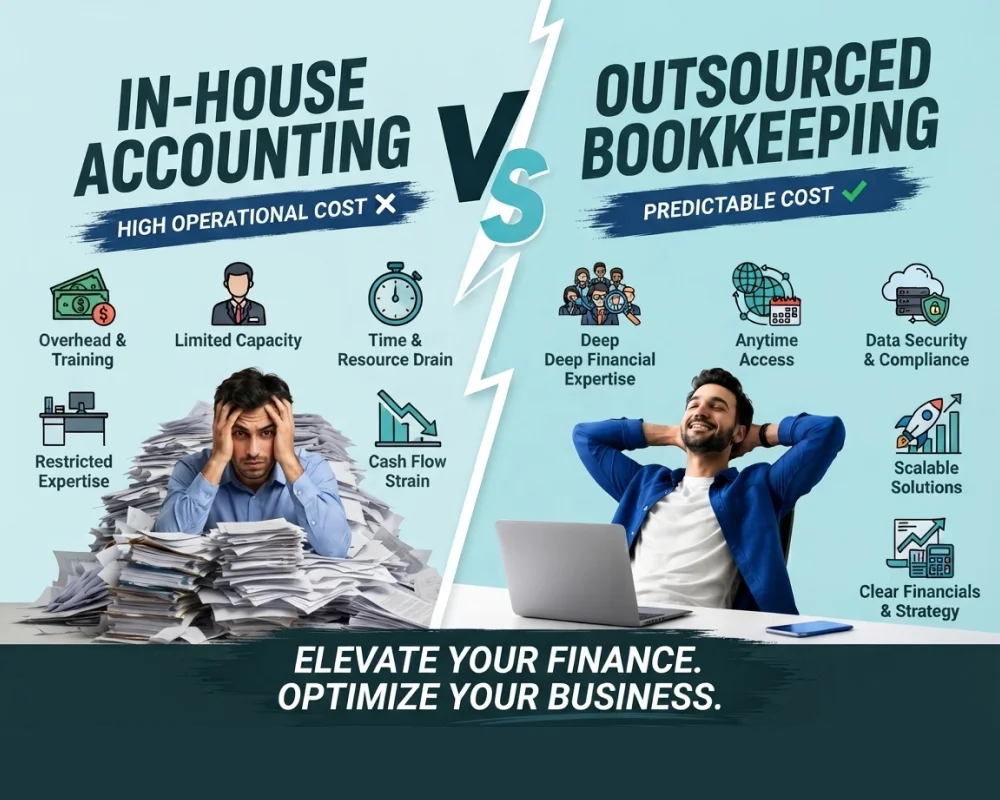
Every business owner eventually faces a pivotal financial question: Should you build an internal accounting team or partner with an external provider? This decision impacts not only your bottom line but also your operational efficiency, growth potential, and peace of mind.
For years, the default approach was to hire an in-house bookkeeper or accountant. The back office finance landscape has evolved significantly. Today, outsourced bookkeeping services offer a compelling alternative that many growing companies find superior.
This comprehensive guide examines the in-house vs outsourced accounting debate from every angle. We’ll explore costs, quality control, scalability, and strategic value to help you determine the best back office finance strategy for your unique situation.
Understanding Your Options: In-House vs Outsourced Accounting
Before diving into the comparison, let’s clarify what each model actually entails.
What Is In-House Accounting?
In-house accounting means hiring employees—bookkeepers, accountants, controllers, or CFOs—to work directly for your company. They become part of your team, using your systems, and operating within your physical or virtual workspace.
Key Characteristics:
- Employees are on your payroll
- You manage recruitment, training, and retention
- Financial operations are fully internal
- Direct oversight and control over processes
What Are Outsourced Bookkeeping Services?
Outsourced bookkeeping services involve partnering with an external firm to manage your financial record-keeping and accounting functions remotely. You access a team of professionals who handle everything from daily transaction categorization to monthly financial reporting.
Key Characteristics:
- Service-based relationship (not employment)
- Access to a team with diverse expertise
- Typically more flexible and scalable
- Often more cost-effective than hiring internally
The Cost Comparison: In-House vs Outsourced Accounting
Cost is often the deciding factor in the in-house vs outsourced accounting debate. Let’s look at the real numbers.
The True Cost of In-House Accounting
When business owners consider hiring an in-house bookkeeper, they often think only about salary. But the total cost is significantly higher.
Full Cost Breakdown for an In-House Bookkeeper:
| Expense Category | Monthly Range | Annual Range |
| Base Salary | $4,000–$6,000 | $48,000–$72,000 |
| Payroll Taxes & Benefits | $1,000+ | $12,000+ |
| Accounting Software Licenses | $200+ | $2,400+ |
| Ongoing Training & Development | $100–$300 | $1,200–$3,600 |
| Office Space & Equipment | Variable | Variable |
| Total Estimated Cost | $5,200–$7,200 | $62,000–$86,000 |
According to the U.S. Bureau of Labor Statistics, the median annual wage for a bookkeeping or auditing clerk was $49,210 in May 2024, while accountants earned a median of $81,680. When you layer in the full cost of employment—including benefits and overhead—the total spend rises considerably above these figures.
Hidden Costs to Consider:
- Recruitment expenses: Advertising, interviewing, and screening candidates
- Turnover costs: When an employee leaves, you lose institutional knowledge and incur replacement costs
- Coverage gaps: Sick days, vacations, and parental leave mean work stops or falls on others
- Compliance errors: Mistakes made by an overworked or underqualified employee can be costly
The Cost of Outsourced Bookkeeping Services
Outsourced bookkeeping services typically operate on fixed monthly pricing with transparent fees.
Typical Outsourced Bookkeeping Costs (2025):
| Business Size | Monthly Cost Range | Annual Equivalent |
| Solo / Startup | $250–$400 | $3,000–$4,800 |
| Small Business (1–10 staff) | $400–$700 | $4,800–$8,400 |
| Mid-Sized (10–50 staff) | $700–$900 | $8,400–$10,800 |
| Multi-Entity / Franchise | $900–$1,200+ | $10,800–$14,400+ |
What’s Typically Included:
- Bank and credit card reconciliation
- Transaction categorization
- Monthly financial reports (P&L, balance sheet)
- CPA-reviewed accuracy checks
- Accounting software management (QuickBooks, Xero)
- Dedicated support team
- No recruitment, training, or overhead costs
Cost Comparison: Real-World Examples
| Business Type | In-House Cost | Outsourced Cost | Savings |
| Solo Consultant | $4,800/month | $300/month | 94% |
| Retail Store | $5,200/month | $550/month | 89% |
| Multi-Entity Agency | $6,500/month | $900/month | 86% |
Even after factoring in occasional CPA reviews, outsourced bookkeeping services average 30–60% cheaper overall than maintaining an in-house team.
Quality Control, Accuracy, and Expertise
Financial accuracy isn’t just about avoiding penalties—it’s about making confident business decisions based on reliable data.
Quality Control Challenges In-House
With an in-house team, quality control depends entirely on the individual(s) you hire. Risks include:
- Single point of failure: One person handling all financial records means no checks and balances
- Limited bench depth: If your bookkeeper is sick or leaves, work stops
- Skills gaps: A single generalist may not have specialized knowledge
- Lack of oversight: Without proper segregation of duties, errors or fraud can go undetected
Quality Control Advantages of Outsourced Bookkeeping Services
Outsourced accounting firms typically implement multi-layer review processes:
- Preparer: Records and categorizes transactions
- Reviewer: Checks for accuracy and completeness
- CPA: Final review and certification
Additional Quality Benefits:
- Established Standard Operating Procedures (SOPs)
- Automated reconciliation and anomaly detection
- Regular audits and performance reviews
- Continuous training on the latest regulations
The In-House Expertise Challenge
Building an internal team with comprehensive expertise is difficult. You might hire a bookkeeper who can handle daily transactions but lacks strategic insight. Or you might hire a CPA who is overqualified for routine tasks but expensive for the role.
Limitations:
- Expertise is limited to what your team knows
- Keeping up with changing tax laws and regulations requires ongoing training
- Specialized knowledge (e.g., industry-specific accounting) may be absent
- Employee turnover means losing expertise
The Outsourced Expertise Advantage
When you outsource to a firm, you gain access to a team of professionals with diverse specializations.
Benefits Include:
- Bookkeepers for daily transaction management
- CPAs for compliance and reporting
- Controllers for financial oversight
- Specialists in your industry (construction, real estate, healthcare, etc.)
- Teams knowledgeable in global compliance and reporting standards
According to research: 90% of employers in the accounting industry face staff shortages and recruitment challenges. The scarcity of qualified accountants has become a critical hurdle for firms aiming to expand. Outsourced bookkeeping services eliminate this recruitment challenge entirely.
Scalability and Flexibility for Growing Businesses
Scalability Challenges In-House
In-house accounting teams struggle to adapt to changing business needs.
Problems Include:
- Hiring lags: By the time you realize you need more capacity, you’re already stretched thin, and recruiting takes time
- Seasonal fluctuations: You’re paying for full-time staff even during slow periods
- Growth bottlenecks: Adding new entities, locations, or revenue streams requires hiring new people
- Downsizing difficulty: Letting go of staff during lean periods is painful and costly
Scalability Benefits of Outsourcing
Outsourced bookkeeping services scale with your business fluidly.
Advantages:
- Add capacity instantly—no hiring or training required
- Scale down during slower periods—no layoffs or severance
- Easily add new entities, locations, or reporting requirements
- Flexible engagement models: full-time, part-time, or strategic partnership
One business owner noted: “When we grew from 2 to 15 employees, our bookkeeping needs multiplied. Outsourcing meant we could add support without the months of recruitment.”
Financial Reporting and Strategic Insight
In-House Reporting: The Pros and Cons
In-house accountants can provide highly tailored reports, deeply aligned with your business operations.
Advantages:
- Real-time access to financial data
- Customized reporting formats
- Deep understanding of your business models
Disadvantages:
- Limited bandwidth for analysis—time goes to data entry
- May lack strategic perspective—too deep in the weeds
- Analytical tools may be limited by software budget
Outsourced Reporting: Elevated Insights
Outsourced bookkeeping services bring professional-grade reporting capabilities.
Benefits Include:
- Standardized reporting formats aligned with best practices
- Industry benchmarking to compare your performance
- Compliance-focused documentation ready for audits and tax filing
- Real-time dashboards for immediate insights
- AI-powered analysis to identify trends and opportunities
According to recent studies, nearly 61% of clients refer to their accountant as their main source of business advice. Outsourced accounting firms enable your team to focus on this high-value advisory role rather than getting bogged down in transactional work.
Technology, Innovation, and Efficiency
The In-House Tech Challenge
Keeping up with accounting technology is expensive and time-consuming for in-house teams.
Costs:
- Software license purchases and renewals
- Ongoing staff training on new features
- Implementation time for new systems
- Integration challenges with other tools
The Outsourced Tech Advantage
Outsourced accounting firms invest in the latest technology across their client base.
Benefits:
- Access to premium accounting software (QuickBooks Online, Xero, etc.)
- AI-powered reconciliation and anomaly detection
- Professional-grade reporting and dashboarding
- Enterprise-level security features
“You get real-time visibility into your financial data as a matter of course, not as an upgrade you have to budget for separately.”
In-House Productivity Limitations
In-house teams often struggle with efficiency due to:
- Single-person dependency: Work stops when the employee is unavailable
- Multitasking demands: The same person handles routine bookkeeping and strategic analysis
- Limited automation: Without investment in tools, manual processes prevail
Outsourced Efficiency Advantages
Outsourced accounting firms leverage:
- Dedicated teams with clear role specialization
- Standardized processes for faster turnaround
- Advanced automation for data entry and reconciliation
- Scalable resources to handle workload fluctuations
Risk Management, Security & When to Choose
Risk Exposure In-House
The in-house vs outsourced accounting decision ultimately comes down to your business needs. When a single employee handles multiple financial functions, risks accumulate.
Common Risks:
- Fraud exposure: Without segregation of duties, embezzlement is harder to detect
- Compliance failures: Missing tax deadlines or filing errors
- Data loss: Accidental deletion or corruption of financial records
- Security gaps: One person holding all access to financial systems
Risk Mitigation Through Outsourcing
Outsourced bookkeeping services build risk management into their operations.
Benefits Include:
- Segregation of duties across different team members
- Multi-layer review for accuracy and compliance
- Enterprise-grade security (encryption, backups, role-based access)
- Compliance expertise to navigate evolving tax laws
When to Choose Each Model: In-House vs Outsourced
Choose In-House Accounting If:
- You need daily physical presence and direct oversight
- Your business has complex internal systems that require on-site management
- You operate at a large scale (e.g., Fortune 500) with a full finance department
- You have highly specialized reporting needs that require on-demand customization
Choose Outsourced Bookkeeping Services If:
- You run a small to mid-sized business looking to optimize costs
- You want CPA-reviewed monthly reports without hiring full-time
- Your business experiences seasonal fluctuations in transaction volume
- You want to eliminate recruitment, training, and turnover headaches
- You need access to specialized expertise without building an internal team
How Back Office Finance Services Make the Transition Easy
At backofficeservices.co, we specialize in providing seamless back office finance solutions that combine the best of both worlds.
Our Approach Includes:
- Onboarding Support: We integrate with your existing systems and processes
- Dedicated Team: You get consistent professionals who learn your business
- Tech-Enabled: We work with your preferred accounting software (QuickBooks, Xero)
- Scalable Plans: Services grow with your business—no surprises
- CPA-Reviewed: Every report is verified for accuracy and compliance
Frequently Asked Questions
What is the difference between bookkeeping and accounting?
Bookkeeping focuses on recording daily financial transactions, while accounting involves interpreting, classifying, analyzing, reporting, and summarizing financial data. Many outsourced bookkeeping services include both functions.
Is outsourced bookkeeping secure?
Reputable providers employ enterprise-grade security including encryption, regular backups, role-based access controls, and compliance with standards like ISO 27001.
Can I switch from in-house to outsourced bookkeeping?
Yes. Most providers offer transition support, including cleanup services to get your books in order before ongoing management begins.
How quickly can I start outsourced bookkeeping?
Many firms can begin within a week or two, depending on the complexity of your financial situation and the state of your existing records.
Do I need both a bookkeeper and an accountant?
Many small businesses benefit from both: a bookkeeper for daily transactions and reconciliations, and an accountant for tax strategy and high-level oversight. Outsourced bookkeeping services often include both functions.
The Bottom Line: Choose What’s Right for Your Business
The choice between in-house and outsourced bookkeeping services—the core of the in-house vs outsourced accounting decision—ultimately depends on your business’s unique circumstances. However, for most growing companies, outsourcing offers a compelling combination of cost savings, expertise, and flexibility that’s difficult to match with an in-house team.
Key Takeaways:
| Factor | In-House Accounting | Outsourced Bookkeeping Services |
| Cost | High ($60,000+/year) | Low ($3,000–$14,000/year) |
| Expertise | Limited to hires | Access to full team |
| Scalability | Slow, costly hiring | Instant, flexible |
| Quality | Variable | CPA-reviewed, multi-layer |
| Technology | You manage, you pay | Included, always updated |
| Risk | Single point of failure | Segregated, secure |
Ready to Explore Outsourced Bookkeeping Services?
At backofficeservices.co, we help businesses make the transition to professional, cost-effective back office finance solutions. Our team provides:
- Dedicated bookkeeping and accounting professionals
- CPA-reviewed monthly financial reports
- Scalable support that grows with your business
- Fixed monthly pricing—no surprises
Free consultation to discuss your specific needs
Let us help you transform your financial operations so you can focus on what matters most: growing your business.